Ambassador Michele B. Bowe, GCM
Holy Family Hospital is the barometer of the economic and political situation in Bethlehem. Simply by noting the condition of the women, newborns and children, one can get a good idea of the current climate in the region. Increases in poverty, food insecurity and joblessness are all evidenced by the condition of the women and children presenting for care at our hospital. It is a sobering picture.
Bethlehem has no governmental social safety net. Families simply make their tables longer to care for extended family members without jobs or salaries. Bethlehem has gone more than 18 months with no pilgrimage activity, and as a result 90% of the workforce remains without income. Work permits for employment in Jerusalem have not been reissued. The checkpoints controlling ingress to and egress from Bethlehem are closed frequently, and Bethlehem has reverted to being a small insular hamlet surrounded by walls.
Holy Family Hospital’s Mobile Clinic, which serves the isolated villages and desert communities of Area C south of Bethlehem with an Ob/Gyn and a Pediatrician, makes its rounds as regularly as the security situation permits. A missed day means a community must wait for another week for medical treatment. Since the Mobile Clinic nurses usually bring a supply of fresh food, milk and blankets, a week without service means a week with less food.
The Midwives and Obstetricians are grateful for our prenatal vitamin distribution and clinic efforts, which promote prenatal care that yields healthier babies and less complicated deliveries. The Hospital is now subsidizing deliveries and care by up to 85% to ensure greater participation in medical care. Even so, with the deteriorating economy, mothers, having missed meals in favor of the children, arrive at the hospital in labor having not eaten, often delivering low birth weight babies.
Holistic care, or cura personalis, is the care of the whole person, focusing on promoting both physical and emotional wellbeing. Holy Family Hospital social workers tend to the social/emotional wellbeing of our patients while also asking about their needs at home. Food insecurity and unheated homes without running water can compromise the health of pregnant women and children. Our social workers can help connect families without access to these basic needs to social service providers in Bethlehem.
Holy Family Hospital Foundation partners with St. Catherine’s Catholic Parish at the Church of the Nativity in Bethlehem in a poverty alleviation program. Our social worker assesses the needs of parish families and can provide grocery, electricity and pharmaceutical cards according to family size. The grocers and pharmacists participate by offering us a twenty percent discount, which permits us to include more families. We currently have 200 families registered in our program; we are committed to magnifying hope for the poorest families.
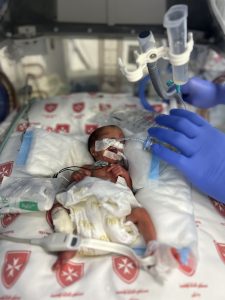
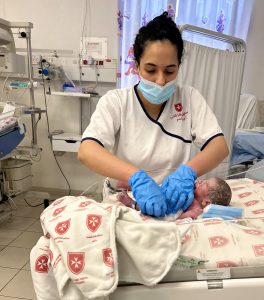
In 2024, Holy Family Hospital delivered 3,902 babies. This number is lower than experienced in recent years as the economic situation has many couples postponing marriages, resulting in fewer first babies. Travel from Hebron, south of Bethlehem, is difficult or impossible, resulting in almost no deliveries from that region. Counterintuitively, while there are fewer newborns, the Hospital’s workload has increased. Complicated deliveries can mean longer stays for mothers and increased admittance of newborns to the NICU.
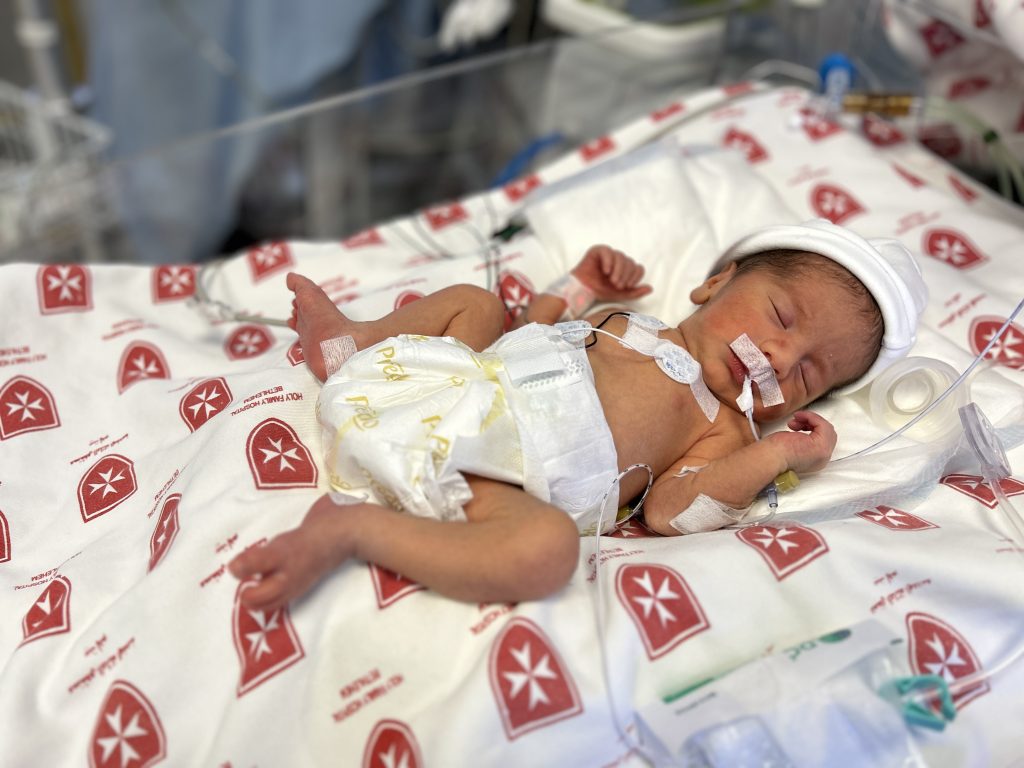
The rate of C-sections is higher by 4% than last year. The incidence of prematurity has risen by 22%, leading to a higher rate of admittance to the NICU. The number of babies staying more than 50 days in the NICU has increased by 113%. The rate of babies born abnormally small has risen by 56%. Hospital statistics like these may seem cut and dry, but these numbers show that we are encountering more and more fragile newborns in need of intensive care. These statistics are emblematic of a suffering Bethlehem falling deeper into entrenched poverty.
Consistent with our philosophy favoring holistic care, our social workers counsel families with fragile newborns on how to cope with anxiety and juggling life with a baby in intensive care and the needs of the rest of the family. The social workers remind the families of our 85% subsidy, which helps ease financial anxiety, and the NICU doctors explain the medical care and needs of the babies, which helps to alleviate their anxiety.
The needs of the 18 to 20 babies in the NICU are obvious to even those with no medical experience. It is less obvious that mothers in labor and newly postpartum also experience emergency need for intensive care. When I was in Bethlehem recently, in a 24-hour period we had 3 mothers experience life threatening medical emergencies during labor. During deliveries the lives of mothers and babies can sometimes hang in the balance. Our doctors stabilized each of these mothers and safely delivered the babies behind closed doors, with only the fathers and nurses there to witness the miracles of lives being saved.
Even with the Hospital’s increased workload, there are still great moments of joy. A successful delivery after complications has the whole staff cheering and high-fiving the exhausted Obstetricians. A premature baby goes home after 50 days in the NICU only after a little celebration with cake and a gift from the NICU staff. Staff birthdays, pregnancies and work anniversaries always require a little department gathering to share a homemade treat and best wishes.
Against the backdrop of conflict and fear in the region, Holy Family Hospital celebrates hope with each delivery and every homecoming. The staff express great devotion and gratitude to Holy Family Hospital. Many members of our staff were born at the Hospital, and it is both their first and last place of employment. We are proud that as a primary work of the Order of Malta, we are committed to paying full salaries on time in an economy where this is a rarity.
Since no one can predict when pilgrims will return and bolster the economy of Bethlehem, Holy Family Hospital will continue to remove barriers to care. We will redouble our efforts to provide the best possible care for the most vulnerable, without regard to need or creed. In 2024, the Hospital increased its subsidies twice to meet the needs of the families in Bethlehem; we will continue to do whatever we can to ease the burdens the community in Bethlehem must bear every day.
As Pope Benedict XVI said, “Those who have hope live differently.” At Holy Family Hospital Foundation, we work throughout the year to enable the Hospital to magnify hope and restore dignity for the mothers and babies of Bethlehem and the region. We make it possible for the Hospital to provide holistic healthcare to all who come through its doors or to its clinics. We cannot change the economic or political situation in Bethlehem, but by providing excellent healthcare, good jobs, training opportunities, educational advancement, and by alleviating poverty, we bring the gift of hope. Hope makes all things possible.